
Some days you have an hour free and feel like exploring something new. Others, fifteen minutes and just enough energy for a hug. The problem is usually not a lack of desire, but trying to apply the same plan to completely different circumstances — and when that plan doesn't fit the day you have, the date is canceled or is experienced as an obligation. In this article, we explain why improvising doesn't usually work, and we propose a simple selector to choose, according to your available time and energy at the moment, what type of encounter makes sense.
Why improvising usually fails
"We'll see what we feel like" sounds good in theory, but in practice, it pushes the entire decision to the exact moment when both of you are most tired and have the least mental space to decide anything — just the worst time to decide anything calmly.
Behavioral psychology has a very solid finding on this: "if X happens, I will do Y" plans — known as implementation intentions — work much better than the simple intention of "we're going to be more intimate." A landmark meta-analysis, which gathered 94 studies with over 8,000 participants, found that this type of specific plans significantly increase the degree to which people actually carry out what they set out to do, compared to those who only have a general intention without a specific plan. The reason is simple: a plan like "if we have 15 minutes and we are tired, we will do X" relieves your brain, at the time of greatest fatigue, from the task of deciding from scratch — the decision has already been made in advance.
This is exactly what fails when we improvise intimacy without any framework: we leave the most important decision for the moment when we have the least capacity to make it well.
The time-energy-intensity selector
The proposal is simple: instead of trying to decide "what do we do" from scratch each time, assess three very specific variables before starting:
- Available time: 15 / 30 / 60 minutes.
- Energy: low / medium / high.
- Desired level of novelty: soft / intermediate / exploratory.
According to the combination, the system suggests a viable encounter format, instead of always forcing the same plan. Some examples:
- 15 minutes + low energy → A gentle sensory ritual: physical contact without a specific goal, presence, and calm.
- 30 minutes + medium energy → A light playful game, with some novelty but no big production.
- 60 minutes + high energy → A more exploratory experience, with more time to try something different.
The importance of this selector is not always hitting the exact right combination the first time, but having a framework that avoids "we don't have time, so nothing" — which is, in practice, the default option when there is no plan.
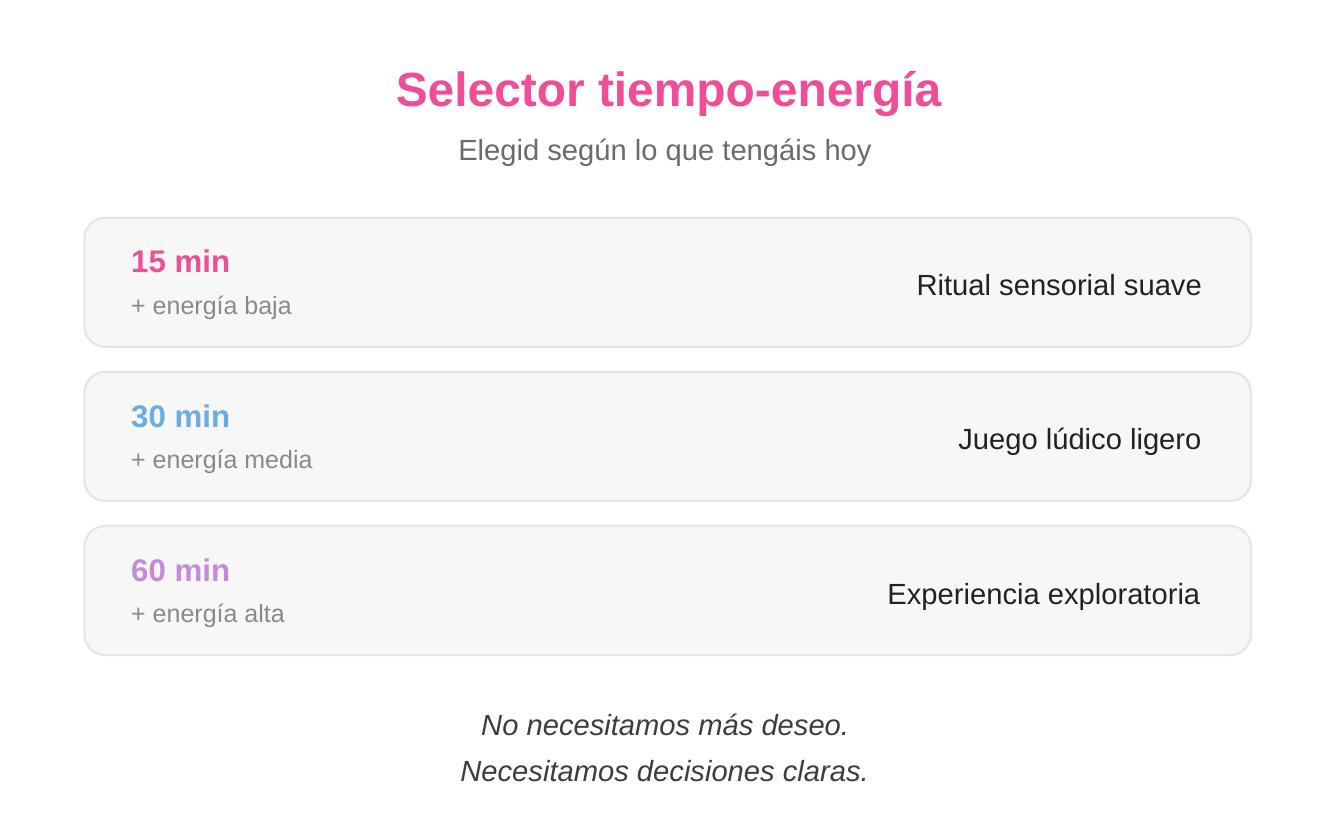
Three date formats: soft, medium, expansive
It's good to be clear about what each intensity level implies, not to force an exploratory format when low energy is present, nor to always remain in the soft zone when there is a real desire for more:
- Soft format: prioritizes connection and presence over novelty. This is the realm of the 5-5-5 method we discussed in a previous article — reconnection, conscious exploration, and affectionate closure in about 15 minutes — ideal when time or energy are limited.
- Medium format: introduces an element of novelty — a game, a new dynamic, a small change of scenery — without requiring much preparation or time.
- Expansive format: when there is plenty of time and energy, it's the time to explore something genuinely new.
Research on novelty in couples supports why it's worth keeping all three levels available, and not just the "all or nothing" extreme: introducing novelty gradually is associated with greater sexual satisfaction and with a greater willingness, by both parties, to continue proposing or accepting new things in the future. And it doesn't depend on each experience being spectacular: couples who sustain activities that are stimulating or novel to them — even if they're small — show more desire and satisfaction than those who only seek one great, memorable moment.

Contextual recommendations without pressure
The selector works best if used as a guide, not as a rigid rule. Some recommendations to prevent it from becoming just another source of pressure:
- There is no “wrong” combination. If on a day with plenty of available time you still feel like a soft format, it's as valid a choice as any other.
- Energy dictates the plan, not the other way around. If midway through an expansive format, energy drops, it's okay to redirect to something softer.
- Material support is optional, never mandatory. For those who want an extra push in the medium or expansive format, a deck of cards, a position dice, or some toy designed for couples can facilitate the "what exactly do we do" part — but the selector works perfectly without any product.
The underlying message, ultimately, is this: we don't need more desire. We need clear decisions. Having a simple framework to choose, according to what is happening that day, removes pressure and makes intimacy no longer depend on the perfect moment appearing.

 How to maintain intimacy in a relationship when you feel like you don't have time
 If the first time wasn't perfect, it doesn't mean we're in crisis
 Couples' Question Game: Truth or Curiosity
 The erotic sandwich technique: asking for what you want without hurting or offending.
 The best sex toys for couples
 Why Stress and Phones Kill Desire in Relationships


