
The pursuit of perfection, the desire for control, and idealization often appear when planning a new event with our partner (a date, an anniversary, etc.). However, reality is often very different from everything we imagine, and the result is not always what we expected. That does not mean it is better or worse, it simply means it is different and that we will need to adapt to what happens.
In this article, we tell you why that first imperfect attempt is not a red flag, but rather a completely normal part of exploring something new together.
The mistake of giving up after one try
Starting a new practice or a new learning experience means that you will have to experience it several times. It often happens that if something does not go as expected, one concludes that it does not suit them, without giving a chance to the potential that the practice has.
Research on sexual novelty in couples points out that trying new things is associated with greater sexual satisfaction, but also with a greater willingness to initiate and accept the novelty proposed by the other (Rosa et al, 2019). In other words, novelty is not an isolated event that “works” or “does not work” on the first try, but something that is built with repeated willingness from both parties.
Giving up after just one attempt closes that door before it has had the chance to fully open.

How erotic learning works
A new practice, whether more or less erotic, has a process of adaptation. The first few times will not be the best version of something because mutual and self-understanding must occur. The pace, the posture, the words, or the gestures that work best between the two people who are connecting.
In this adaptation process, the disappointment is confused with the specific outcome of the activity/practice and the disappointment with the relationship.
Paying attention to the sensations you have when trying something new and concluding that it is not for you, is totally valid. The conflict arises when it is generalized and it is believed that the couple is not compatible or that one is not enough for the other. Sometimes, it simply happens that that practice does not fit in the relationship due to specific tastes, or that it has not been experienced long enough to learn to enjoy it.
Repair conversation in 3 steps
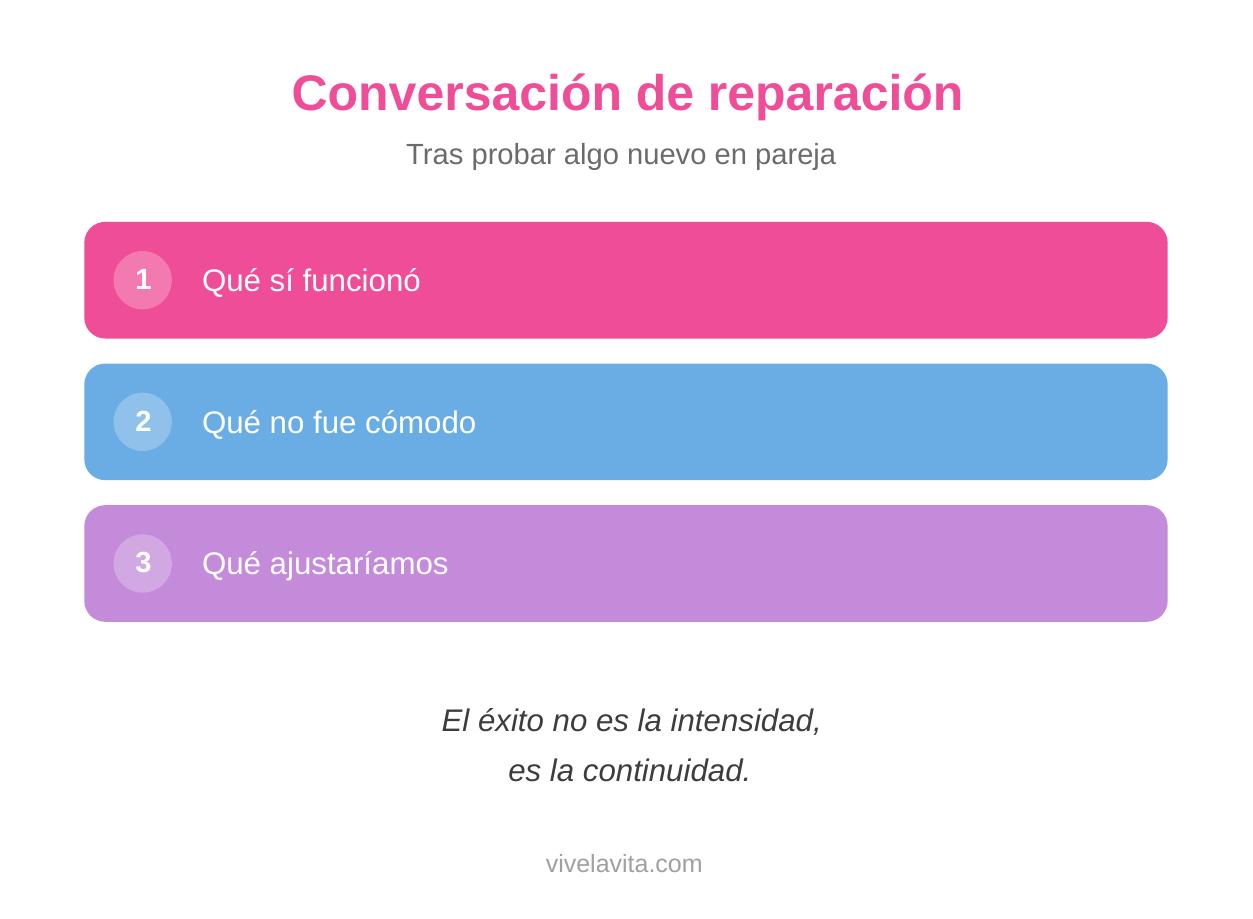
The proposal from Vivelavita is to have a brief conversation with your partner after the erotic encounter, new practice, new activity, etc., through three questions:
- What worked. Even if the whole experience did not go as expected, almost always there is an element that did generate connection or pleasure. Name what you enjoyed.
- What was not comfortable. Talk naturally about what did not generate the expected pleasure, it is not a complaint to your partner, it's stating what does not fit with you or your tastes at this moment of practice.
- What would we adjust. The question that turns the conversation into something useful for the future: do change the rhythm, the moment, the posture, the communication during the encounter?
This model has a very specific function: avoiding personalizing the outcome. Making the process shared, as an experiment between both people seeking their pleasure.
The question being answered is not “what did we do wrong?”, but “what would we adjust?”
Progressive adjustment without pressure
In the 1970s, Masters and Johnson developed the sensate focus technique precisely to lower the pressure of “getting it right the first time”: instead of pursuing a specific result from the first try, they proposed moving forward in stages, allowing time for the body and the couple to adjust before raising the expectations.
That same logic of continuity is what supports the most recent research on desire in long-term relationships: couples who introduce novel activities over time, not as a one-off event, but as something that repeats and adjusts, show greater desire and satisfaction than those seeking a single perfect and memorable moment (Muise et al, 2019).
If you want to delve into how to handle a sudden mishap during an already usual encounter (not when trying something new, but in everyday life), we have a specific article on what to do when something goes wrong during sex.
You can always consult the team at VivelaVita for guidance on sexual education and recommendations from sexology professionals to work with you in your specific situation, both individually and as a couple.
💜 Your well-being is our raison d'être; thank you for letting us be part of it.


 How to plan an intimate date according to your time and energy
 Couples orgasm: Marina Castro debunks major sexual myths
 The erotic sandwich technique: asking for what you want without hurting or offending.
 Relationship dynamics: How to play the fantasy mailbox to connect and improve communication
 How to maintain intimacy in a relationship when you feel like you don't have time


