
The lack of time is a current problem and an enemy of intimacy. This article focuses on this factor, present in some relationships, and proposes the 5-5-5 method to practice brief and constant connection between two people.
Why passion doesn't die from lack of desire, but from lack of space
Paying full attention to the encounter with the other person can become a privilege when one is overwhelmed with many daily tasks or responsibilities.
From the cognitive-behavioral therapy of couples, authors like Beaucon or Epstein advocate for repetitive daily exchange as the construction of the bond in a more powerful and lasting way than if done only with big occasional moments.
A 2021 study published in the journal Contemporary Family Therapy, authored among others by researchers from Baucom's team, confirms this idea with data: the strongest predictor of closeness and satisfaction in a couple was not the total time spent together, but the time spent talking in an ordinary and everyday way, without the need for it to be a special event.

The myth of “if we don't have an hour, it's not worth it”
When time is limited by work, children, family care, etc., the idealization of having a long time to dedicate to intimacy in a couple disappears and never arrives. Then the couple stops being intimate in their day-to-day and stops cultivating desire.
Intimacy requires quality in the attention of the present time shared with the other. Feeling seen, desired, and present for a few genuine minutes creates connection and cultivates intimacy in the couple.
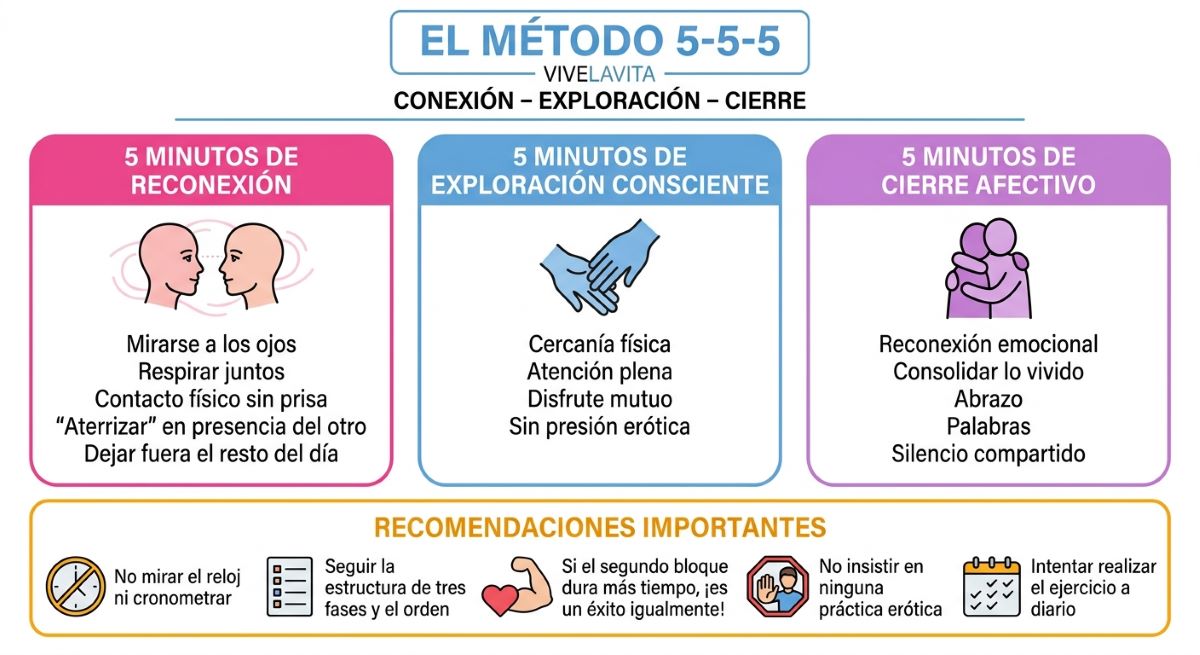
The 5-5-5 method (connection – exploration – closure)
From VivelaVita comes a daily activity to create intimacy in a couple:
- 5 minutes of reconnection: looking into each other's eyes, breathing together, seeking physical contact without haste. The goal of this block is simply to “land” in each other's presence, leaving the rest of the day behind.
- 5 minutes of conscious exploration: dedicated to physical closeness with full attention, without the pressure of it having to necessarily lead to anything more.
- 5 minutes of emotional closure: a space to reconnect emotionally after the encounter (e.g., a hug, some words, staying in shared silence for a moment) that consolidates what was experienced in the previous minutes.
Consider the following when performing the exercise:
- Do not look at the clock or time it.
- Just keep the three-phase structure in mind and follow the order.
- If the second block lasts 5 minutes one day and 15 minutes another day, it is a success all the same.
- Do not insist on your partner performing any erotic practice.
- Try to do the exercise daily.
How to create sustainable micro-rituals for busy couples
For the exercise to work in the long term, it is recommended:
- Keep it truly small: a ritual that can be fulfilled even on the most tired days is a ritual that is sustained over time. If it starts to feel like a big obligation, it is abandoned as quickly as any other ambitious goal.
- Have a fixed trigger: associating it with a specific time of day (after putting the kids to bed, before sleeping, a set day of the week) helps it become a habit and not depend on “finding the time.”
- Complement, don't replace: these micro-rituals do not have to eliminate longer encounters when the occasion arises.
- Talk about it as a couple: proposing it openly, instead of forcing it in the moment, helps both people experience it as a shared agreement and not as a unilateral demand.
When this method is not enough
This exercise works when the couple is affected by a lack of time to cultivate intimacy, not when there is an unresolved underlying conflict.
If what you lack is not time but emotional connection, broken communication or an unresolved disagreement, no micro-ritual will solve that on its own and forcing it may even generate more frustration.
If the problem lies in communication, this article on how to improve communication in a couple may help you.
I hope the information you found in this article is useful, and if you need a personalized approach for your specific case, you can contact the VivelaVita team for recommendations of sexology professionals in your city.
💜 Your well-being is our reason for being; thank you for letting us be part of it.

 How to plan an intimate date according to your time and energy
 If the first time wasn't perfect, it doesn't mean we're in crisis
 Why you "leave" your body during sex (and how to come back)
 The erotic sandwich technique: asking for what you want without hurting or offending.

 Self-esteem and relationships: why you can't place your happiness in another person


