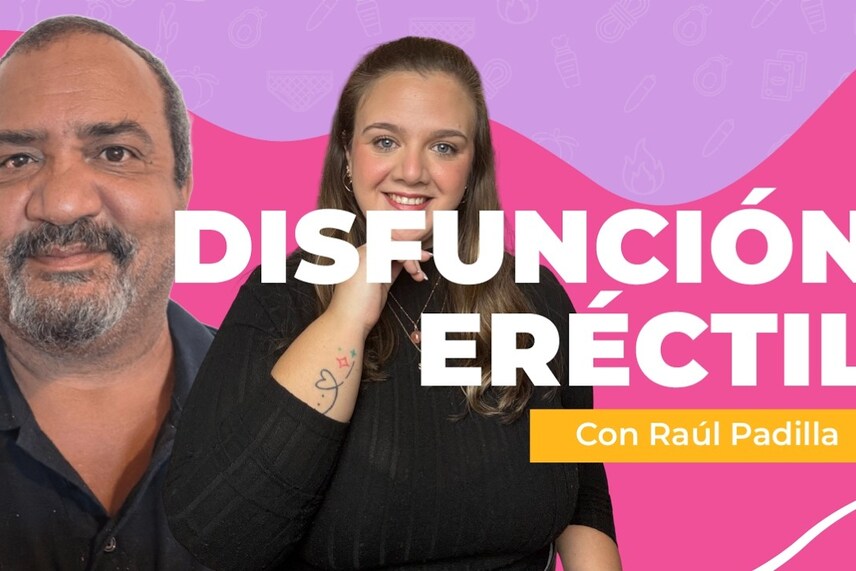
When talking about erectile dysfunction, we often think of physical causes or age. But there is a very common psychological phenomenon that is rarely discussed: the spectator role. In the interview we conducted on our YouTube channel, psychologist and sexologist Raúl Padilla explains why our own mind can become the biggest obstacle during sex and how the vicious circle between anxiety and performance forms.
If you want to learn more about the topic or watch the full interview with Raúl, you can do so on the VivelaVita YouTube channel:

What is the spectator role in sex?
The spectator role (in English, spectatoring, a term described by researchers Masters and Johnson) involves observing and evaluating oneself from the outside during sexual intercourse, instead of experiencing it.
Raúl compares it to what happens when someone stands in front of a camera and is told to "act natural": it's impossible because something that should happen spontaneously becomes planned, analyzed, and judged. This constant evaluation and self-criticism are the spectator syndrome.
According to him, in women it can lead to anorgasmia or reduced lubrication, and for the latter, there are lubricants. In men, the effect is usually more dramatic as it results in difficulty achieving or maintaining an erection.
The vicious circle between performance anxiety and erectile dysfunction
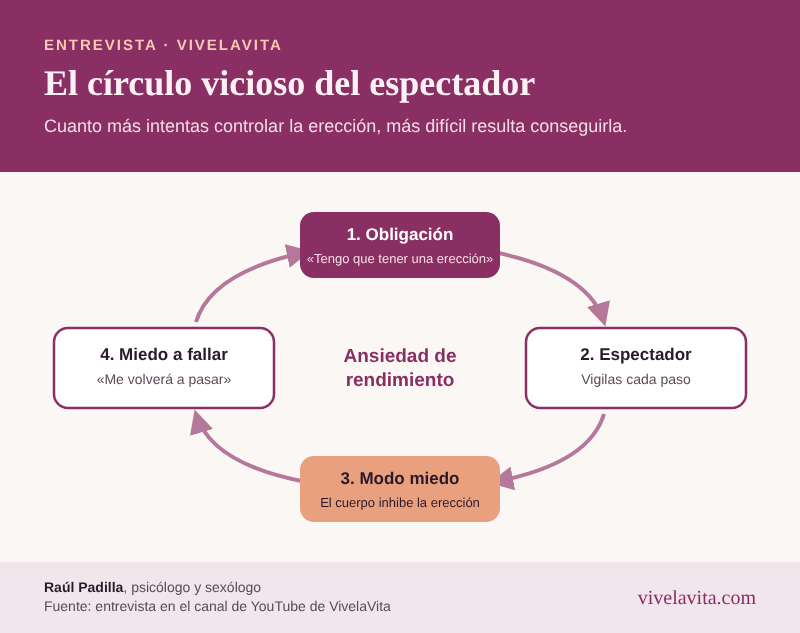
For Raúl, the origin lies in turning sex into an obligation: "if I love you, I must give you pleasure." This idea installs a plan in the mind and makes the person supervise every step to make it go well.
The more you try to control the erection ("I must have an erection, it must last"), the harder it becomes to achieve.
He explains it with a very graphic analogy: if we have a limited amount of blood and "two heads," the one that goes to the upper one (the one that thinks and monitors) disappears from the lower one. And he adds another key idea: what we experience as an obligation ceases to be a desire and loses its appeal.
This loop usually starts in two ways:
- Due to received sexual education, often based on porn, which conveys that sex is about performance and that you must always be at 100%.
- From a specific episode: one day you aren't in the mood, you've eaten too much, or something distracts you, there is no erection, and fear appears: "it will happen again."
In both cases, the person ends up monitoring their erection instead of enjoying everything in front of them. And, as Raúl reminds us, there is life beyond penetration.
Why anxiety blocks erection
The anxiety overlaps with the desire phase of the sexual response, "the butterflies." When what we have in front of us is appealing, the nervous system activates to pursue it. But when the brain interprets it as a threat, it shifts to fear, danger, and rejection mode, and it doesn't lead to arousal or orgasm.
This is why, Raúl explains, some men cannot achieve an erection even with medication: they are so scared that their brain reacts as if a lion were to appear, and in a danger situation, the body inhibits erection. Paradoxically, the observer role appears because we want things to work, and we pay so much attention that they stop working.
What role does the partner play?
For Raúl, the partner is a "secondary actor": fears and demands come from the individual, who tries to look good and satisfy their partner. Behind this is often inadequate sexual education that presents the man as the pleasure-giver and penetration as the only thing that matters.
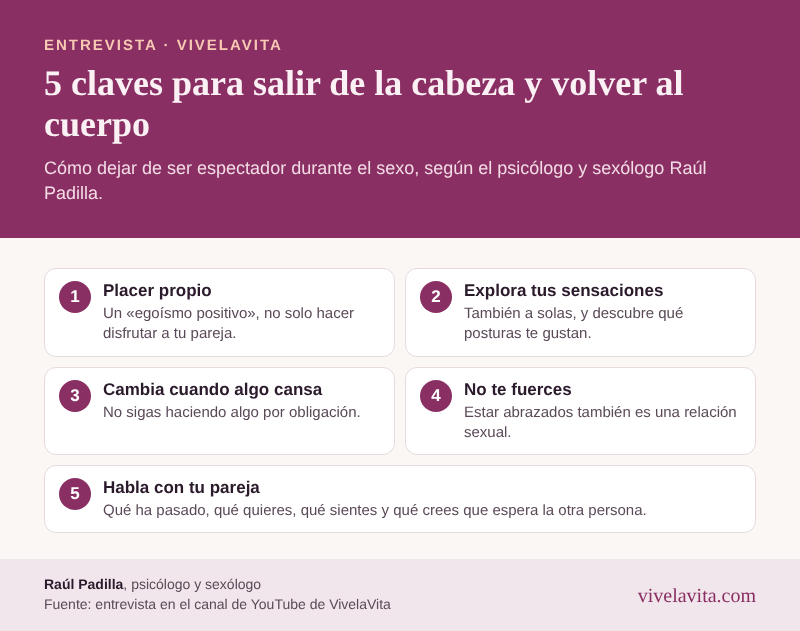
What the partner can do is talk. Raúl emphasizes the importance of communication: it doesn't have to be in bed or during sex, but it should happen at some point, to discuss what happened, what each person wants and feels, and what they think the other person expects. He often observes in consultations that the idea someone has of what their partner thinks doesn't match what their partner actually thinks.

How to get out of your head and back into your body
These are the keys Raúl Padilla shares in the interview:
- Make a "click": understand sex as your own pleasure, a "positive selfishness," instead of experiencing it solely as the obligation for your partner to enjoy. According to Raúl, achieving this change means having won 50% of the battle.
- Explore your sensations, even when you are alone, and discover which positions and stimuli you like best.
- Change when something becomes tiring, instead of continuing out of obligation.
- Don’t force yourself: if you’re not in the mood, you don’t have to do it, no matter how much a "alpha male" role is expected of you.
- Ask yourself why: when in doubt about "how can I last longer," Raúl invites you to think about why you want to last longer, and reminds that sex is not a competition. Being in each other's arms is also a pleasurable sexual relationship.
- Seek professional help if this situation worries you or affects your well-being.
If erection problems persist, it's also important to consult a healthcare professional to rule out physical causes.
Resources that can help you
Besides professional support, at VivelaVita you have a selection of products for erection problems and cock rings, which can help maintain a firmer erection. If it's your first time, our blog explains how to put on a cock ring.
Raúl Padilla provides in-person consultations in Madrid, in the Retiro area, and also via videoconference or phone. He offers home visits in specific cases, like agoraphobia, and organizes sexual growth groups and occasional workshops. You can learn more about his work on his website: raulpadilla.es. If you need to resolve any doubts, you can contact the Vivelavita team, and we will assist you with professional guidance.
💜 Your well-being is our reason for being; thank you for letting us be a part of it.

 Why you "leave" your body during sex (and how to come back)
 Why Stress and Phones Kill Desire in Relationships
 Couples orgasm: Marina Castro debunks major sexual myths
 The erotic sandwich technique: asking for what you want without hurting or offending.
 Comparison of the best sex toys for Lesbians
 The 12 best remote or app-controlled sex toys


